XLr8
XLr8
What do I bring to an Organization?
Elite-level Production Advancement
Bentley Civil Software Expertise in Road, Site, and Drainage Scopes - as broad and deep as anyone - backed by engineering design and production experience.
Workspace/Configuration Expertise - there are two scopes here: the 12-layer workspace technical stack (files/syntax) and understanding the details of the Engineering Tools. I've been hacking the tech stack and using the tools for over thirty years. Includes ProjectWise Integration (CSBs).
Elite-level Systems/Business Transformation
While there are many general training and business analysts, I would argue that few well-practiced Civil Engineers have deeper understanding and experience in these fields and are actively applying their earned insights to directly supporting Civil Engineering organizations.
Training Systems Design/Implementation
I've led a wide variety of training implementations. Here's my short current recommendation: force compliance (like your HR-required training). Really consumable, short, focused training, managed and enforced by Learning Management System.
Training Content/Curriculum Development
The key: really short focused training blocks. I helped Bentley with their Next Leap Forward in 2013 (which coincided with the first OpenRoads training): modernizing their Multi-Day Training model to a Two-Hour Modular Training model. Why two hours? Because that was the contemporary time slot for workshops at user conferences. The Next Leap Forward in all training material is MicroLearning: only what you need.
If I were to pick a cap right now, I'd say: no training longer than 29 minutes. Why? "Less than half an hour" can be justified as in-line production billable. Note: that you need a good Learning Management System (LMS) and active curation (smaller chunks means more chunks to manage and deliver).
Communication Systems
I've been running websites since 1999; simple HTML back then, now full Content Management Systems (CMS). I prefer Joomla, for its power and extensibility. Teams, SharePoint..
Litmus Test: No one should need more than five minutes to know who the leads are and those experienced in any specialization. It shouldn't take more than five minutes to find your corporate or client recommendations for any common workflow.
"We can find anybody with any skill in two phone calls."
Not good enough. "That is hardly a resilient reliable system, and it took you ten years to get to a point where you know who that first call is."
SharePoint: the default communications platform for every engineering organization - but none of the engineers know how to use it. This is the biggest blindly accepted contradiction in engineering. I can simplify the learning curve to four easy skills. (Expect some publications on that shortly).
Mindset
Paranoid Hyper-Capitalist: Grow or Die!
Learning Quickly is the best way to succeed. Learning More Quickly than your Competitors is the way to win market share. Your Learning Rate is your Primary Leading Indicator of Success.
If something important is not being used, make it easier to use. Iterate to success.
The Project Managers hold the key to learning (budget and resource availability). They need to understand the risks, especially to schedule and budget and the hidden risks of using outdated practices and tools. My job is to explicitly lay out the cost/schedule and eliminate their rightful fear of the risks. Engineers like to learn, but they don't like flailing. Systematically, skill adoption needs to be very consumable (29-minutes or less (because less than half an hour of directly-applicable skill adoption over an 8-hour day should be as billable as less than half an hour of reviewing client standards and specifications)).
Succeed at Scale, Sustainably. Very little of what we do is one-off. Fix substandard processes AND ENSURE the Better Practices are shared and incorporated across the enterprise. A properly designed and curated expertise sharing system ensures the breadth and longevity of success.
Examples: Experience
- Details
- Category: XLr8
Hi. Jeff here.
I have a LOT of content across my webs. I tend to go into a lot of detail - I'm used to documenting step-by-steps for training and for execution plans. I tend not to write for quick consumption until later passes - after a lot of the framework has been laid out.
Here are my biases in how I apply my decades of civil advancement experience:
Strategize. Design for Scalability. Act Intentionally.
And Proselytize:
There is enough suffering in the world without having to work in outdated, unprofitable (or underprofitable), error-prone chaos.
Life is short. Time is precious. Working better is living better.
Towards that end, if I could leave you with a one-word mantra:
Modernize.
Most of the rest is why and how.
Quick Link: How to Modernize your Training
Quick Link: Increasing Capacity vs solving the Capacity GAP <-- which matters more?
We are Products of Our Past
(But we shouldn't be bound by software products from the past.
Really. The industry has passed them by. Don't let the industry pass you by.)
I've found that "Here's what's broken. Here's how to fix it." directness is appreciated as an outside consultant (talking to the enterprise's liaison), but internally, to leadership and peers, that message needs to be handled with great delicacy and patience.
Everyone's current Status Quo was a Bold Leap Forward at one time - something to be proud of. That effort should continue to be lauded. And that very same Older Leap Forward is likely out of date and in need of immediate transformation. The need to modernize does not negate the earlier breakthrough.
"I was really successful doing it this way."
"When was this?"
"Seventeen years ago."
"How much bigger are you now?"
"We have four times the offices."
"Have you updated your methodologies since then? Are you scalable now?"
Judging current success from past metrics overlooks current opportunities.
"We've shaved 5% design labor from a similar project a year ago."
"Did you use any new tools and techniques or were your staff just more familiar with the tools? Are your success metrics based on old standards or what you could - and should - be achieving with current Best Practices?"
Maybe a gentler pre-amble to that question might be "How would you like to shave 20% off?"
If we want to a clear understanding of our current opportunities, we need to modernize our metrics to include gains available through today's (and tomorrow's) Best Practices.
Old familiar workflows are unlikely to actually be low-risk; they're just familiar.
It's Time for the Next Leap Forward
The first step in moving forward is an honest accurate appraisement of where you are right now, relative to
- recognized Best Practices in your industry, and
- the leaders in your field(s).
Decision makers need to
- have no doubt where the industry leaders are and the Best Practices that made them industry leaders,
- understand where they and their teams stand relative to the leaders
- the value and cost of moving forward
- have a Strategic Adoption Plan for all industry Best Practices
- "Do not Adopt" is valid
- Triggers for adoption should be explicit
- have a Strategic Adoption Plan for all industry Best Practices
- Use Metrics cognizant of those Best or Bestest Practices.
The challenge in technology adoption isn't technology. It's psychology.
Here's the friction:
Leadership and Managers (and sometimes the most remote resource) tend to be reflexively protective of the Status Quo. For that horse you led to water, it doesn't help to push his head into it.
Change can be risky - if it's not well managed.
Engineers universally enjoy learning, particularly if its immediately applicable (it's why they're engineers, not scientists).
But they don't like flailing. They don't like the uncertainty of having to make decisions in a hurry outside of a scope they are well-practiced in (most training requires a lot of chasedown and evaluation - adapting generic material to their specific needs. It's not the training they don't like, it's the uncertainty.
Project Managers see training as high risk to schedule and budget. They want to defer that risk until a later high-margin, slow-pace project.
Their fears are well-founded as they have seen time and budget burned by poorly-designed and poorly-escorted learning. Again: the uncertainty is the stressor.
Relevant Expertise and Experience Matters
Engineers are trained to solve problems well. They tend to excel at their primary focus.
Given time they will converge to decent results in just about anything. But, on their own, they may not reverse-engineer their way to Best Practices. Given Proper Guidance - exposure to the relevant Best Practices - and experience implementing, they will likely excel.
If you'd like low-risk, high-confidence, low-cost Civil Engineering continuous learning, seek an expert in Civil Engineering Training Design and in Training Delivery.
It's what I've been doing been doing for the past thirty years.
My most Urgent Digital Advice
Update: August 2026
Make training as consumable as possible - and then use force.
If you can get your training chunks to less than 30 minutes (including the time it takes for the designer to find, start, finish, and start applying), you'll reach a success threshold (including being able to bill the training).
Once your training becomes easily consumable, use force. Learning Management Systems (like Pinnacle or learning.bentley.com) support assigning training and tracking progress.
Consider your HR Training. Nobody takes that voluntarily, and, yet, compliance approaches 100%. That should be inspire your success model.
After the Training is Fixed:
Within your organization, within your core operations, and towards new opportunities, here's what your biggest Success Multiplier is: your Expertise Sharing Systems, specifically, and your Platform Mastery in general.
Expertise is best: Well-Shared
Your organization's greatest asset is its people - specifically, their expertise. If you are not investing in the growth of your shared expertise, you are missing out on your greatest multiplier. Every important specialization's experts should be sharing their talent with each other and with all the contributors in that specialty.
(if 11-minutes is too long, then you can skip straight to the 90-second lede Specialty Collaboration Forums build Systemic Synergy (and they're easy)*)
Many organizations just default to Microsoft Teams for collaboration (very limited) or SharePoint (which few engineers know how to use well).
Internal discussion boards/forums like Bentley Communities or Reddit are easily and inexpensively implementable and can provide the foundation for a culture of synergy and uplift - a culture of shared contribution and continuous improvement. Imagine if the best ideas of your brightest minds were informing the decisions of all your staff.
Why leave this greatest opportunity to chance?
Growth Opportunities in Infrastructure Infrastructure
The growth in the infrastructure industry - in your enterprise, the new work you win – lies in:
- Reality Integration
- Construction Engineering & Inspection
- BIM
- Digital Delivery
- Digital Project Integration.
I can bring 35+ years of technology adoption to your future.
I can help you improve your present as well.
Drive the Revolution - Infrastructure Digital Integration (BIM and Digital Delivery Adoption)
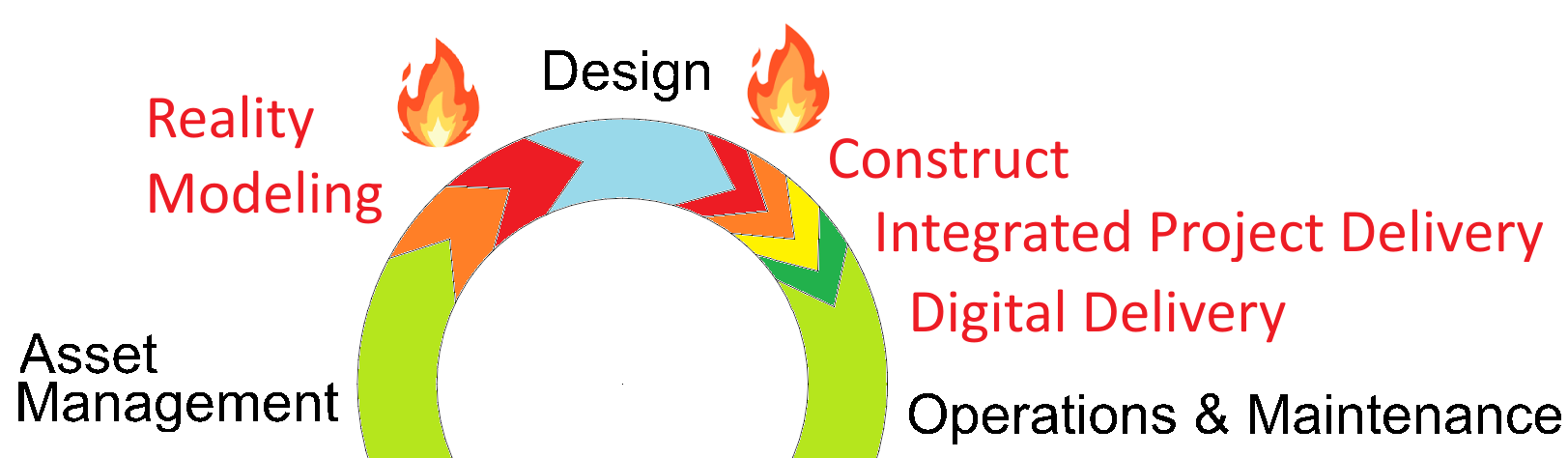
Uplift: Comprehensively Designed, Optimally Shared
Training is best: Consumable (Lean, Findable, Updateable)
As our software platforms become increasingly fat and margins remain unyieldingly thin, the wiggle room lies in making training lean.
For the consumers: Just Enough. Just In Time. At Their Fingertips (easily findable).
For the creators/sharers/training managers: Findable, updateable (to extend shelf life and reach).
Here are some examples that are more easily updateable than a PDF and far more consumable than an unindexed one-hour meeting recording (stored in a File Pile).
Free Training Content: Item Types and View Display Rules
Your Digital Tomorrow Starts Today!
Item Types and View Display Rules are the technologies that enable Digital Delivery, permitting and taming BIG DATA. You can - you must - start using them right now. It's easy. It's profitable.
Free Training Content: Ponds in ORD
CivilHelp.com > Pond Design in ORD
Very lean training on how to Design Ponds in ORD: I wrote this because there was a gap - an important, very complex workflow with no available training (Bentley used to have a couple of classes that spanned this subject, but they "went away").
Pond Grading (Templates for Pond 3D Modeling)
some constrained-area solutions for 3D pond grading (complements Bentley's Basin Civil Cell which works upward and outward).
"Better Every Day" is NOT Good Enough
You gotta be better, FASTER than your competition.
My OCD: I am a "Bigs" Fixer
(90 seconds)
Prepare for the Future
We're at an exciting time in the industry - the biggest revolution since dropping the pencils: Digital Delivery at the DOT level. Integratability as a requirement. Here's the secret: the technology that makes integration possible, Item Types (or Property Sets in the Autodesk ecosystem), can improve your quality and save you money right now. As in, the project you're currently working on now. Item Types and View Display Rules are the technologies that unleash - and tame! - the power of The Big Data Age we're in. Lead now or be left behind.
For BIM-ready Drainage and Utilities you have two platforms: OpenRoads Drainage and InfoDrainage. These are really heavy platforms = high risks in implementation. You WILL want an implementation plan to adopt these beasts. Get help; "winging it" is ruinous.
Stay Lean - But Level Up
Our modern design and delivery platforms are really fat. Training is fat. Projects are lean. How do we resolve this?
First of all, make use of Learning.Bentley.com. It's the standard. It's modular, AND you are likely already paying for it.
Second: find or build lean alternatives or gap-fillers (there are a lot of gaps).
Third: effectively share your customs or "leans" with your full user base.
I can help with all three of these.
Links
Driven by Experience: What I've Done
Quick Links: YouTube Channel JeffMartinPE | My Resume | About this web
- Details
What skills and attitudes drive me to your success?
- My dad built businesses (and subdivisions and office parks).
- My first job as an EIT was with a three-person office. We surveyed, designed, and staked out. I even cold-called developers seeking work (thank you, Recession 1990-1991).
- Packed up and left Florida for a three-month consulting contract in San Diego. Turned into a five-year engagement.
- Founded Civil XLr8 to “Go National”. Not wanting to hire staff, I instead took a local job at CalTrans, before ultimately working directly for Bentley Systems for 13 years.
Upon sending my kid off to college, I restarted Civil XLr8.
-
To maximize firmwide uplift, it starts with your communication systems.
Your communications systems must
- maximize the scalability of your value and
- maximize the synergy of your people.
It should be
- Manageable from the top
- Engaging across the base
- Value-Harvestable
- Manageable and Managed
Those in need must be able to find what they need when they need it.
- Just Enough, Just in Time, at their Fingertips
How do we do this better? Are our limitations valid? Do we really have to wait?
Tools. I'm happiest when I'm bringing order to chaos (see The Six-Ball Juggle). Some processes are near impossible without tools that simplify them. Engineers can work wonders with a spreadsheet, but at some point they themselves get too complex and breakable (without reliable ways to tell if they're broken). If I could make a living programming, I'd do it. My scope is different.
I have freely published some software programs.
- FlowMonster is/was a hydraulic normal depth calculator that the City of San Diego used for over twenty years - saving them hundred(s) of thousands of dollars.
- Ini Manager - I wrote this so to make the InRoads enterprise-wide Standards Management possible. Community Involvement (and Quality Practices in general) require contribution to be easy - or it fails.
I tend not to program anymore, but I do customize XSL/T reports. OpenRoads Configuration/Administration is complex to the point of absurdity - and the primary way to review in bulk (and import/export for mass manipulation) is via Exporting/Importing XML files. XSL/T transforms to and from those standard formats into formats you can actually use.
Innovative Communication. There is nothing really innovative in using websites to communicate. Except in managing civil engineering projects. We tend not to do that. The first project I used a website to educate the stakeholders about the decisions they would be making and the results of our discussion was Oklahoma DOT - MicroStation & InRoads Migration). Amazing results and surprise contributions from across the state (because they had access to all the information). Today I document as I go; I can provide instantaneous access to all project stakeholders: Fast, Lean, Secure Project Websites
Agile Implementations made possible by Constant Communication (Live documentation)
Vision and Effective Communication are critical to moving organizations. I led the City of San Diego's Engineering Application Services programs in the late 1990s. I led the technical aspects of Oklahoma DOTs migration from MicroStation/J and InRoads to v8. I have designed training programs for large corporations. I have helped shape expectations and culture. I have consistently improved communication and sought to develop a culture of Uplift Everybody and Shared Expertise. I know the value of injecting energy and instilling confidence.
US-183 North Mobility Project, Austin, TX, $612 million. Drainage Modeling and Sheeting in OpenRoads Drainage and Utilities on ProjectWise. Parsons Corp.
JFK International Airport Redevelopment Program, New York. $1.24 billion. Drainage Modeling and Design using Civil 3D/SSA on AutoDesk Construction Cloud.
Valley Line West - Edmonton Light Rail (Utilities) in Edmonton, Alberta. Subsurface Utilities using OpenRoads Drainage and Utilities on ProjectWise.
- I made extensive use of ORD BIM capabilities, integrating data from disparate sources into the utilities data model.
- I then used View Display Rule technology (my favorite new platform tech behind Item Types) to streamline the review process. In-project ROI!
- Watch The Six-Ball Juggle for my thoughts on simplifying complex processes.
Drainage/hydraulics has been the most ever-present discipline in my career. Fresh out of school designing and permitting drainage systems in rainy Central Florida.
In what would be typical throughout my career, deep drainage experience in the Roadway Software ecosystem (InRoads, GEOPAK, Civil 3D, OpenRoads) means you're most valuable leading in that role. At Intergraph, I helped develop the algorithms for full-flow/surcharged HGL calculations (this was before HEC-22). Even most recently, when added to Multi-discpline Mega Projects, my expertise is more rare and valued in the Drainage and Utilities realm than in the roadway scope (a video perspective).
The OpenRoads Drainage and Utilities software is really two complicated technology verticals grafted together. Elite expertise in BOTH those verticals is rare. My career has largely been about intergrating those two verticals (and otherwise blurring barriers).
Drainage Engineering: a summary
Intergraph Corporation: While primarily focused on InFlow (drainage) and InSewer (sanitary) development, certification and support, InRoads was the Civil behemoth. It’s impossible to work the periphery without a good competency of the core. I also certified the InSpan (bridge) software package.
- Highway Interchange Design: I-4/Conroy, Rural Highway Design, Bridge Geometry support (HNTB Orlando).
- Foothill Transportation Corridor - South Alignment Studies with full templates and complicted end-conditions. (PBS&J, Irvine)
- I-15 Managed Lanes Direct Access Ramp geometry modeling and drainage (CalTrans).
- I-805 Managed Lanes (Kimley-Horn, San Diego).
Highway Engineering: my history.
I started my career with a full-services Topo-to-Stakeout Site Engineering company. A PE, an EIT and me. Lots of responsibility right away.
- Job 1: Full project responsibility early site engineering including drainage in very rainy Florida (Spring Creek Square - 30-acre shopping center working directly with the developer and contractor).
- Job 2: Site and drainage design and permitting for Orange County Public Schools Improvement programs
- Job 3: Intergraph InSite certification lead.
- Site grading course design at Bentley, including InRoad, the InRoads (GEOPAK)Site Modeler import/graft, and first OpenRoads Site Grading Courses.
- Here's some valuable training on grading: CivilHelp.com: Site and Drainage Grading
First Job: On the rod or the Leitz Set 2 for topo or stakeout surveys.
Most currently, agency-level configuration of OpenRoads Survey, including Custom Operations and Annotation setup and import/process QC.
Quick Links: YouTube Channel JeffMartinPE | My Resume | About this web
- Details
Better + Faster = Excelerate = XLr8
I'm not a "salesman", but I firmly believed I could save InRoads users (and offices) enough time and improve quality enough to make a living.
Twenty-five years ago I started a company to do that full time: provide civil engineering training and consulting services.
Saving time is about speed AND quality. Speed without quality does not save time.
Faster must be coupled with Better:
Excel + Accelerate = Excelerate = XLr8
I called my company Civil XLr8.
Twenty-five years later, I can still sum up what drives me in those four letters: XLr8
Grow or Die!
It's a race. We either grow or we die. So, business development is Job #1.
How do we do that? Differentiate from the competition. Deliver better. Focus on and invest in growth sectors.
In Transportation Design growth areas include: BIM/Digital Delivery, Digital Twins, The Full Digital Pipeline.
How do I help businesses win work?
I get them good at the project design and delivery infrastructure today. And help get them ready for tomorrow.
Customer service starts with the relationships, but then it's the deliverables. Do you give clients what they want? More than they want? Are you a Trusted Partner?
The design infrastructure comes in two platforms: AutoDesk and Bentley. That's it. You need to be very good at the platform your client demands. Better than your competitors.
Design Platform Adoption
Are you going to really good early or sort of good later? Lead or follow?. Leadership earns more contracts!
HEAVY Platforms
OpenRoads is a heavy platform. It is layered. It's full of surprises. It's built for integration and live-updates - NOT for simplicity and speed.
OpenRoads Drainage is the heaviest design technical stack I've seen in 35+ years, and it's not even close.
It is not business as usual. Implementation and adoption is not business as usual.
What does it take to get Competent? What does it take to get Good? How do you not blow up Project Budgets?
How much and when?
You want to be strategic about how you implement.
You may not fully build out your plan, but you definitely need to plan out your plan.
How much work do you have now/soon? How much more do you expect to win? How critical is this client? Is the platform broad? If you're asking if you should learn OpenRoads if your clients are largely DOTs, that's an easy answer: Yes! A more nuanced question is "when should I prepare to adopt OpenRoads Drainage when it's not explicitly required yet?"
I help organizations get really good with the platform.
Fix Your Macros!
You can fix your Micros, but you absolutely need to evaluate your Macros - your Big Systems, your BIg Multipliers.
I've seen money spent on fixing little things, when Big Multipliers are grossly neglected.
- The micro might be teaching formal classes or developing effective self-study training courses (lean!).
- The macro is XLr8ing your implementation, adoption, and expertise-sharing systems - in scalable and, ultimately, self-sustaining systems
What are your biggest Macros? Your Biggest Multipliers?
- Communications (manageable and harvestable expertise-sharing systems (peer-to-peer and expert-to-expert)
- Your internal Learning and expertise-sharing Systems
How: enhance your default standard (Sharepoint, most likely) or build an integrated custom (it's not particularly expensive or difficult)
A final argument (final on this page anyway): what we do we do over and over and and over and over...
Benefits now benefit everyone ever after
What I've done: What I've Done
Quick Links: YouTube Channel JeffMartinPE | My Resume | About this web
- Details
Win More Work!
In the corporate race, we either grow or we die. So, business development is Job #1.
How do we do that? Differentiate from the competition. Deliver better. Focus on and invest in growth sectors.
In Transportation Design growth areas include: BIM/Digital Delivery, Digital Twins, The Full Digital Pipeline.
How do I help businesses win work?
I get them good at the project design and delivery infrastructure today. And help get them ready for tomorrow.
Customer service starts with the relationships, but then it's the deliverables. Do you give clients what they want? More than they want? Are you a Trusted Partner?
The design infrastructure comes in two platforms: AutoDesk and Bentley. That's it. You need to be very good at the platform your client demands. Better than your competitors.
Your Design Platform: How Good Are You?
The tools are set. They're not going away.
(60 seconds)
Are you going to really good early or sort of good later? Lead or follow?. Leadership earns more contracts!
Getting Good Costs the Same Early or Late. Why Wait?
Getting good costs the same whether you get good early or get good late. Why wait?
(36 seconds)
Business as Usual? These are HEAVY Platforms
OpenRoads is a heavy platform. It is layered. It's full of surprises. It's built for integration and live-updates - NOT for simplicity and speed.
OpenRoads Drainage is the heaviest design technical stack I've seen in 35+ years, and it's not even close.
It is not business as usual. Implementation and adoption is not business as usual.
(38 seconds)
Can you Adopt a Fat Platform on a Lean Project?
What does it take to get Competent? What does it take to get Good? How do you not blow up Project Budgets?
How much and when?
(62 seconds)
You want to be strategic about how you implement.
You may not fully build out your plan, but you definitely need to plan out your plan.
How much work do you have now/soon? How much more do you expect to win? How critical is this client? Is the platform broad? If you're asking if you should learn OpenRoads if your clients are largely DOTs, that's an easy answer: Yes! A more nuanced question is "when should I prepare to adopt OpenRoads Drainage when it's not explicitly required yet?"
I help organizations get really good with the platform.
Fix Your Macros!
You can fix your Micros, but you absolutely need to evaluate your Macros - your Big Systems, your BIg Multipliers.
I've seen money spent on fixing little things, when Big Multipliers are grossly neglected.
- The micro might be teaching formal classes or developing effective self-study training courses (lean!).
- The macro is XLr8ing your implementation, adoption, and expertise-sharing systems - in scalable and, ultimately, self-sustaining systems
(73 seconds)
What are your biggest Macros? Your Biggest Multipliers?
- Communications (manageable and harvestable expertise-sharing systems (peer-to-peer and expert-to-expert))
- Your internal Learning and expertise-sharing Systems
How: enhance your default standard (Sharepoint, most likely) or build an integrated custom (it's not particularly expensive or difficult)
(150 important seconds)
Do you want to do Slow Over and Over or Awesome Over and Over?
A final argument (final on this page anyway): what we do, we do over and over and and over and over...
Only by sharing your expertise broadly and quickly will you ensure that you are working Awesomely.
(110 seconds)
What I've done: What I've Done
Quick Links: YouTube Channel JeffMartinPE | My Resume | About this web
- Details