Hi. Jeff here.
I have a LOT of content across my webs. I tend to go into a lot of detail - I'm used to documenting step-by-steps for training and for execution plans. I tend not to write for quick consumption until later passes - after a lot of the framework has been laid out.
Here are my biases in how I apply my decades of civil advancement experience:
Strategize. Design for Scalability. Act Intentionally.
And Proselytize:
There is enough suffering in the world without having to work in outdated, unprofitable (or underprofitable), error-prone chaos.
Life is short. Time is precious. Working better is living better.
Towards that end, if I could leave you with a one-word mantra:
Modernize.
Most of the rest is why and how.
Quick Link: How to Modernize your Training
Quick Link: Increasing Capacity vs solving the Capacity GAP <-- which matters more?
We are Products of Our Past
(But we shouldn't be bound by software products from the past.
Really. The industry has passed them by. Don't let the industry pass you by.)
I've found that "Here's what's broken. Here's how to fix it." directness is appreciated as an outside consultant (talking to the enterprise's liaison), but internally, to leadership and peers, that message needs to be handled with great delicacy and patience.
Everyone's current Status Quo was a Bold Leap Forward at one time - something to be proud of. That effort should continue to be lauded. And that very same Older Leap Forward is likely out of date and in need of immediate transformation. The need to modernize does not negate the earlier breakthrough.
"I was really successful doing it this way."
"When was this?"
"Seventeen years ago."
"How much bigger are you now?"
"We have four times the offices."
"Have you updated your methodologies since then? Are you scalable now?"
Judging current success from past metrics overlooks current opportunities.
"We've shaved 5% design labor from a similar project a year ago."
"Did you use any new tools and techniques or were your staff just more familiar with the tools? Are your success metrics based on old standards or what you could - and should - be achieving with current Best Practices?"
Maybe a gentler pre-amble to that question might be "How would you like to shave 20% off?"
If we want to a clear understanding of our current opportunities, we need to modernize our metrics to include gains available through today's (and tomorrow's) Best Practices.
Old familiar workflows are unlikely to actually be low-risk; they're just familiar.
It's Time for the Next Leap Forward
The first step in moving forward is an honest accurate appraisement of where you are right now, relative to
- recognized Best Practices in your industry, and
- the leaders in your field(s).
Decision makers need to
- have no doubt where the industry leaders are and the Best Practices that made them industry leaders,
- understand where they and their teams stand relative to the leaders
- the value and cost of moving forward
- have a Strategic Adoption Plan for all industry Best Practices
- "Do not Adopt" is valid
- Triggers for adoption should be explicit
- have a Strategic Adoption Plan for all industry Best Practices
- Use Metrics cognizant of those Best or Bestest Practices.
The challenge in technology adoption isn't technology. It's psychology.
Here's the friction:
Leadership and Managers (and sometimes the most remote resource) tend to be reflexively protective of the Status Quo. For that horse you led to water, it doesn't help to push his head into it.
Change can be risky - if it's not well managed.
Engineers universally enjoy learning, particularly if its immediately applicable (it's why they're engineers, not scientists).
But they don't like flailing. They don't like the uncertainty of having to make decisions in a hurry outside of a scope they are well-practiced in (most training requires a lot of chasedown and evaluation - adapting generic material to their specific needs. It's not the training they don't like, it's the uncertainty.
Project Managers see training as high risk to schedule and budget. They want to defer that risk until a later high-margin, slow-pace project.
Their fears are well-founded as they have seen time and budget burned by poorly-designed and poorly-escorted learning. Again: the uncertainty is the stressor.
Relevant Expertise and Experience Matters
Engineers are trained to solve problems well. They tend to excel at their primary focus.
Given time they will converge to decent results in just about anything. But, on their own, they may not reverse-engineer their way to Best Practices. Given Proper Guidance - exposure to the relevant Best Practices - and experience implementing, they will likely excel.
If you'd like low-risk, high-confidence, low-cost Civil Engineering continuous learning, seek an expert in Civil Engineering Training Design and in Training Delivery.
It's what I've been doing been doing for the past thirty years.
My most Urgent Digital Advice
Update: August 2026
Make training as consumable as possible - and then use force.
If you can get your training chunks to less than 30 minutes (including the time it takes for the designer to find, start, finish, and start applying), you'll reach a success threshold (including being able to bill the training).
Once your training becomes easily consumable, use force. Learning Management Systems (like Pinnacle or learning.bentley.com) support assigning training and tracking progress.
Consider your HR Training. Nobody takes that voluntarily, and, yet, compliance approaches 100%. That should be inspire your success model.
After the Training is Fixed:
Within your organization, within your core operations, and towards new opportunities, here's what your biggest Success Multiplier is: your Expertise Sharing Systems, specifically, and your Platform Mastery in general.
Expertise is best: Well-Shared
Your organization's greatest asset is its people - specifically, their expertise. If you are not investing in the growth of your shared expertise, you are missing out on your greatest multiplier. Every important specialization's experts should be sharing their talent with each other and with all the contributors in that specialty.
(if 11-minutes is too long, then you can skip straight to the 90-second lede Specialty Collaboration Forums build Systemic Synergy (and they're easy)*)
Many organizations just default to Microsoft Teams for collaboration (very limited) or SharePoint (which few engineers know how to use well).
Internal discussion boards/forums like Bentley Communities or Reddit are easily and inexpensively implementable and can provide the foundation for a culture of synergy and uplift - a culture of shared contribution and continuous improvement. Imagine if the best ideas of your brightest minds were informing the decisions of all your staff.
Why leave this greatest opportunity to chance?
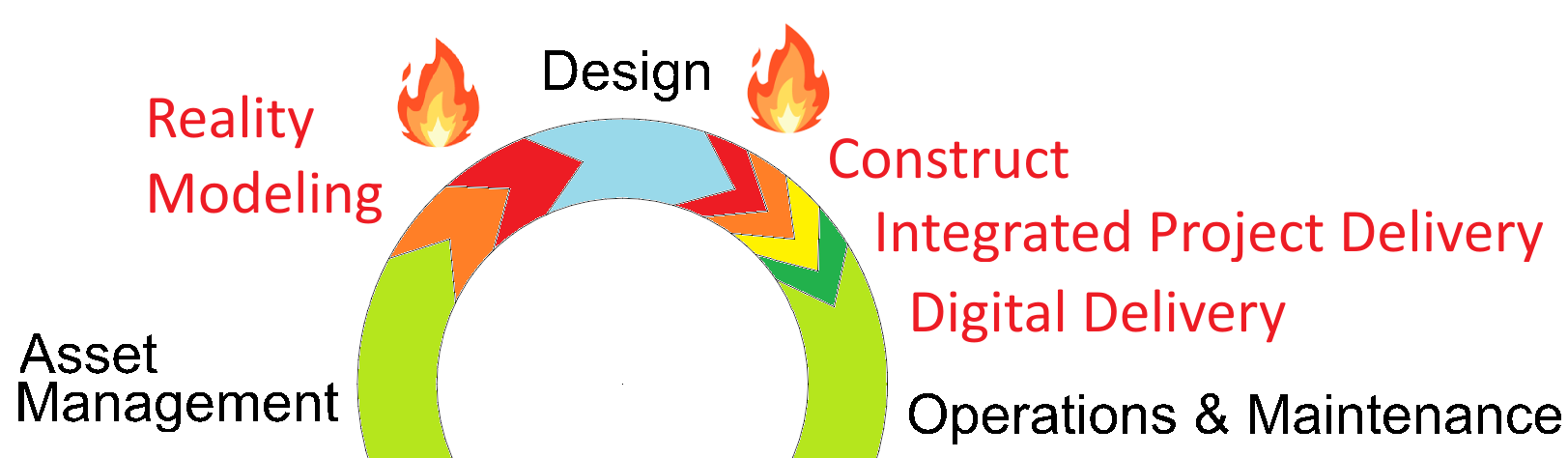
Growth Opportunities in Infrastructure Infrastructure
The growth in the infrastructure industry - in your enterprise, the new work you win – lies in:
- Reality Integration
- Construction Engineering & Inspection
- BIM
- Digital Delivery
- Digital Project Integration.
I can bring 35+ years of technology adoption to your future.
I can help you improve your present as well.
Drive the Revolution - Infrastructure Digital Integration (BIM and Digital Delivery Adoption)
Uplift: Comprehensively Designed, Optimally Shared
Training is best: Consumable (Lean, Findable, Updateable)
As our software platforms become increasingly fat and margins remain unyieldingly thin, the wiggle room lies in making training lean.
For the consumers: Just Enough. Just In Time. At Their Fingertips (easily findable).
For the creators/sharers/training managers: Findable, updateable (to extend shelf life and reach).
Here are some examples that are more easily updateable than a PDF and far more consumable than an unindexed one-hour meeting recording (stored in a File Pile).
Free Training Content: Item Types and View Display Rules
Your Digital Tomorrow Starts Today!
Item Types and View Display Rules are the technologies that enable Digital Delivery, permitting and taming BIG DATA. You can - you must - start using them right now. It's easy. It's profitable.
Free Training Content: Ponds in ORD
CivilHelp.com > Pond Design in ORD
Very lean training on how to Design Ponds in ORD: I wrote this because there was a gap - an important, very complex workflow with no available training (Bentley used to have a couple of classes that spanned this subject, but they "went away").
Pond Grading (Templates for Pond 3D Modeling)
some constrained-area solutions for 3D pond grading (complements Bentley's Basin Civil Cell which works upward and outward).
"Better Every Day" is NOT Good Enough
You gotta be better, FASTER than your competition.
My OCD: I am a "Bigs" Fixer
(90 seconds)
Prepare for the Future
We're at an exciting time in the industry - the biggest revolution since dropping the pencils: Digital Delivery at the DOT level. Integratability as a requirement. Here's the secret: the technology that makes integration possible, Item Types (or Property Sets in the Autodesk ecosystem), can improve your quality and save you money right now. As in, the project you're currently working on now. Item Types and View Display Rules are the technologies that unleash - and tame! - the power of The Big Data Age we're in. Lead now or be left behind.
For BIM-ready Drainage and Utilities you have two platforms: OpenRoads Drainage and InfoDrainage. These are really heavy platforms = high risks in implementation. You WILL want an implementation plan to adopt these beasts. Get help; "winging it" is ruinous.
Stay Lean - But Level Up
Our modern design and delivery platforms are really fat. Training is fat. Projects are lean. How do we resolve this?
First of all, make use of Learning.Bentley.com. It's the standard. It's modular, AND you are likely already paying for it.
Second: find or build lean alternatives or gap-fillers (there are a lot of gaps).
Third: effectively share your customs or "leans" with your full user base.
I can help with all three of these.
Links
Driven by Experience: What I've Done
Quick Links: YouTube Channel JeffMartinPE | My Resume | About this web