Leadership
Curation is the Overlooked Enabler
I felt the most important job when I was at Bentley - after we had "really good coverage" of the primary scopes of OpenRoads - would to curate that content. Without curation, even excellent signal gets lost in noise [[note: we never did curate it, we just published it into the learn server. If you've been there, you know it's noise.]]
Proactive Curation puts content right in the face of those who need it.
Stopping at "the content is available" is one of those "Mission Accomplished" moments. If content is not findable, it's not "available". Value not curated is value lost. In every ecosystem.

Bentley's learn server is a giant bucket of all noise. They should have an OpenRoads Curator so that OpenRoads learners can find the valuable Signal buried in that all-program noise. Without them making their content more consumable, it's up to us.
In fairness, even a consumer-oriented Learning Management System (LMS) like Pinnacle Learning Systems is a labryinth off-the-shelf. So. Many. Options.
I myself tend to defer any curation when I'm busy. I tend to create first, promote it and hope "currency = curation." It doesn't. Noise overwhelms, unless Signal is boosted.
Immediate Steps to Better Learning
Start Curating the content you already have.
Don't wait. (Never wait to be better.)
- Prioritize your primary needs (recognize the primary audiences (roles/"personas" (training industry term)).
- Identfiy current best content for each. Even if it's not easily consumed (it is what it currently is).
- Get the recommendations to your audiences.
Develop your Force System
- (Your Force System is more properly termed a Learning Management System - an LMS.)
- You already have capabilities included with learning.bentley.com - use them.
- Have an adoption and strategy for your permanent LMS. Learning.Bentley.com has custom content capability, but vendor-neutral LMS's like Pinnacle Learning Systems allows an "all-in-one" capability.
Force It!
- To ensure compliance, you absolutely need a assignment and tracking system. Consider your HR-mandated training: 0% interest, 100% compliance.
- It doesn't matter how "eager" your staff is. It doesn't matter how good your Pull System is. If you want assured results, you need to ensure. Assign, Track, and Badger.
- Curation is still essential: you need to know what to assign.
- The more consumable the learning content (the more granular), the more effort needs to go into its curation and its promotion.
- You are essentially transferring all the "slop time" away from your deadline-constrained designers over to a proactive resource
- you allow your production staff to stay highly productive longer (fewer deadlines missed)
- The bigger the scale, the more efficient this transfer becomes
- when the training so short enough to be billable, you pay for the centralized overhead
- You are essentially transferring all the "slop time" away from your deadline-constrained designers over to a proactive resource
more here: Training: Use the Force
- Details
- Category: Leadership
Two-hours is better, but that's still Too Big
|
I was Bentley's Civil Training Content Lead when we transformed our training from the "Multi-day Instructor-led" model to the "Modular self-training" model. "It's not about how we want to teach. It's about how they want to learn." Two-hour blocks was a giant leap forward then, but it's too big an ask nowadays. That's not how they want or are able to learn (due to time and budget constraints). (I'll talk Bentley specifics here, but the issues span the industry.) |
 |
It's time for the Next Leap Forward: Billable (micro)learning.
Let's make the goal measurable: 29-minutes from need to mastery.
If you spend less than half-an-hour making the remaining 7.5 hours of your day dramatically more productive, that should be billable, yes? We often spend more than 30 minutes reviewing client standards and specifications - and billing for that.
29-minutes or less solves the two major roadblocks to training: availability and cost.
To be clear, your total learning time won't be reduced by orders of magnitude. There is a lot of fat and bloat that can be trimmed off, reducing training total training time by maybe 30%. But learning just what you need just when you need it is better learning: direct application solves the need immediately - no need to have to retain the lesson for months. In Training Industry Best Practice lingo: "Just Enough, Just In Time."
Note: "Microlearning" is actually a better term: "micro" implies a constraint. "Just Enough" is an optimization goal for which it is too easy to say "three days is 'Just Enough.'" Microlearning compels thinking "as short as possible".
There's work involved...
The content needs to be parsed down from the 2-hour default. There is some work required here.
Bentley designed a lot of their training to fill a two-hour block. Why? To fill a conference workshop session and make in-person training agendas easier to bundle. That constraint of scheduling convenience overrode the "Just Enough" training industry paradigm.
Better Training Practices
Beyond the "Two Hour" block, there are some other training design suboptimizations and inconsistencies. If you're going to atomize the existing content for easier consumability, be aware of the opportunities:
- OpenRoads training is not consistently "sub-scoped". Exercise 3 typically requires you to work through Exercise 1 and 2.
- Setting up "Exercise Datasets" (or "Jumpaheads") are the quickest way to atomize the multi-hour courses into smaller chunks.
- Courses often start "from scratch," with Exercise 1 often creating new files from seed and attaching references.
- Basically, the first ten minutes of a course is overhead for something you already know how to do
- Ironically they don't have a standalone short course on best practices on how to set up a project
- Basically, the first ten minutes of a course is overhead for something you already know how to do
- the target audience is almost always a single monolith: designers, with little consideration for consumers
- there are more consumers than designers and 100% of the "consumer skills" are valuable for designers
- a little data cleanup opens up the content to a much broader audience
- a good portion of those consumer "evaluation skills" are critical in ensuring the accuracy of in-process design.
- there are more consumers than designers and 100% of the "consumer skills" are valuable for designers
- Sometimes the "shiny new tool" is emphasized over more fundamental tools. More of a marketing/sales intent than good training design.
- "Training Design" is often simply linear "Process Documentation" for a single learner role - the process an experienced sole designer would take on a typical project - it's not "designed" training.
- The most egregious example of this was "Generating Reports" was deferred to Chapter 10 of 13, because reports are required as deliverables after the design is complete. A manager wanting to learn to generate a report would have to sit through eight chapters of content they will never use.
- "Single Pass" training mentality (related to "Documenting the Guru's Workflow" habit).
- My favorite examples are with Laying Out Drainage Structures: there are over a dozen things that have to go right in placing an inlet. The last thing you want to do is throw in all the bells and whistles (like Civil AccuDraw) and have any expectation that any of the students will nail it. If you do not immediately provide troubleshooting instructions, you will have derailed 99% of self-learners.
- Have multiple passes for very complicated workflows. Iterated "Incremented complexity" boosts self-learning success
- Best practice is to start with a sandbox. Give the learner space to play around, troubleshoot and iterate.
- The good news is that "sandbox examples" are very easy to add.
Actions
Catalog your target content. You can feed the course PDFs into AI to get an idea of which Exercises are "Ready to Train" and which are continuations of previous chapters (no "Start Here" dataset).
Build Exercise Starter Datasets. Someone will have to work through the courses, saving milestones. "Beginners" can work through this and save the files. This can be crowdsourced.
Fix the low-hanging Inconsistencies and Slop. This is where experience in the software and training design matters. Sometimes something is made unnecessarily complex, or a new tool is a better solution. Sometimes the payoff isn't worth the time investment. Sometimes there is some time-consuming, completely out-of-scope workflows thrown in for no justifiable reason. Sometimes a lot of time can be saved with a little cleanup.
Get the content to the learners (see below).
There's a (centralized) Consequence...
You always need to manage your content (Curation - the Overlooked Enabler). As your content gets more granular, there's more to manage. More granular means more specialized, meaning more varied target audiences. More to manage, more to curate.
The curation investment return is at-scale benefit to your production/billable staff.
Making the smaller training chunks findable (pull) and assignable (push) requires a robust LMS
- You need a successful "Pull" LMS, where learners can find the most appropriate content quickly.
- You can see that current repositories/servers bury you with noise to flex their "quantity".
- More content forces the need for better content management
- Well-tagged data still needs to work with the interface. "AI agents" still lack the expertise between the training audience roles and most appropriate content.
- More courses means more learning paths to recommend and track - that's an additional LMS challenge and Curator challenge.
Don't Forget Force
To ensure compliance, you absolutely need a assignment and tracking system. The ability to force compliance. Consider your HR-mandated training: 0% interest, 100% compliance.
We talk a bit about LMSs in Curation - the Overlooked Enabler
- Details
- Category: Leadership
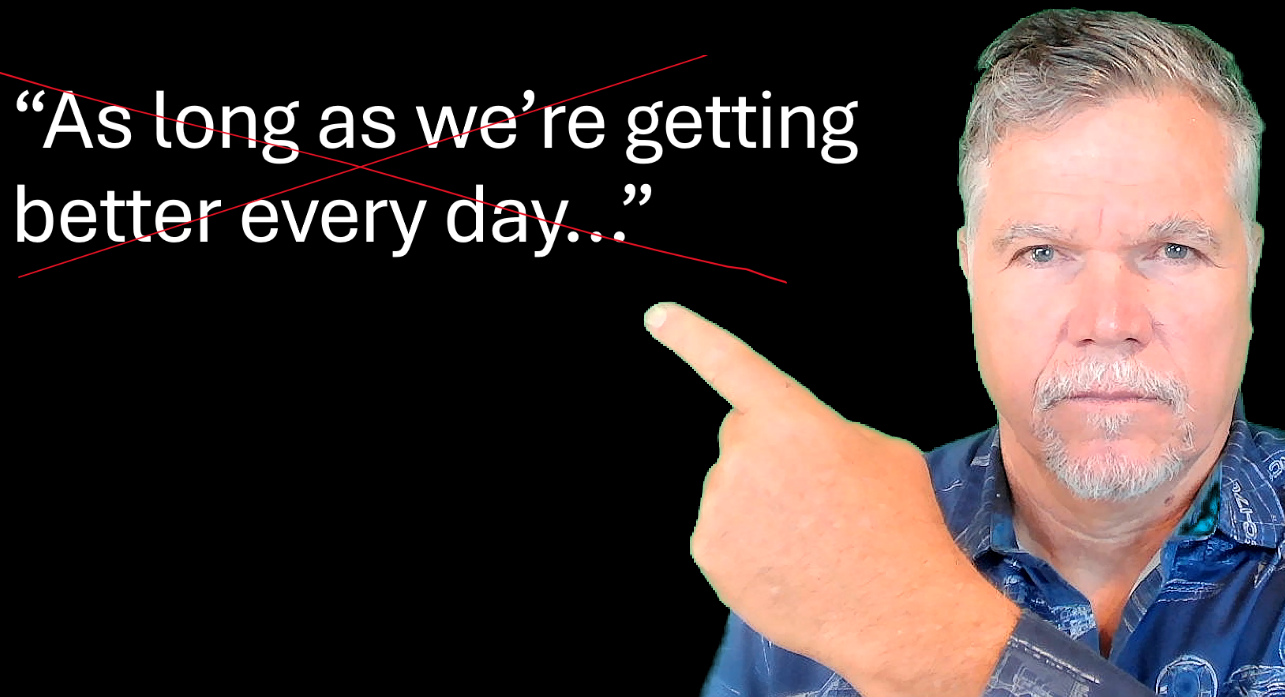
"Better every day" is NOT good enough:
You have to be getting better - FASTER than your competitors!
It's easy.
Start with the Decision to be better faster.
Learn better practices.
Choose the best fits.
Promote an expertise-sharing culture.
Provide the systems and tools to maximize your effort.
- You likely already have capable platforms (underutilized but in place)
Find out how to be better faster: Contact: Jeff Martin, PE
(picture for web preview)
- Details
- Category: Leadership
DEI at its heart IS heart.
I'm as much an insider as there can be (outside of the ultra-rich), but I've felt the pain of Outside.
I cannot claim to know the lived experiences of any but the most privileged. I am NOT a "protected class". But I can extrapolate.
I am among the most privileged class. Cishet white male. Grew up Middle Class - briefly upper middle, sometimes free-lunch poor. Very engaging, always a smile. And for a while, beautiful in the way that all young and smiling youth are (as seen from my now-old eyes). In short, I was about as welcome as welcome can be.
And still I struggled.
I can count being majorly uprooted eleven times, including five different elementary schools. Only one involved a “community” actively gatekeeping. But even the “easy” took time.
The military does it all the time. It's part of their culture, and they know how to handle it. They have programs to welcome, support, integrate. They invest in their culture. Why? They have to; it's a volunteer army.
My family was alone, winging it.
In only one move was I bullied. I learned to lean in fast, but it still took time to become accepted. Cumulative years on the (very narrow) outside.
In my last uprooting, I remember the graciousness of the Open Gym Volleyballers. A team of younger, more skilled players “adopted” me and made it a point to make me feel welcome. I was not one of them, but they intentionally chose to be kind. After a few months I left them (with thanks); I was self-conscious about burdening them (I later learned that a skilled tall middle blocker is ideal, but a clumsy tall middle blocker is still pretty valuable). But their support helped me until I found my niches. Thirty years later, I still feel deep gratitude towards them.
Intentional kindness matters. Intentionally promoting awareness of those who may need support matters. Intentionality matters. It can make a difference. It does make a difference.
Of late, the “forgotten” middle class is coming to grips with feeling left out – left out of the American Dream. Note: “coming to grips” is defined by Merriam-Webster as “understanding or dealing with a difficult situation or problem usually skillfully or efficiently.” We’re not doing that. Quite the opposite.
It saddens me that the popular “solution” to the core problem - wealth flowing unsustainably upward – is to attack the powerless. In part because only those who control the wealth distribution can change the wealth distribution. Further Othering the least powerful will solve nothing. It’s a master stroke in redirection.
A movement that explicitly targets the traditionally neglected to intentionally and systematically re-neglect them only sows pain.
I re-imagine my vulnerable times with the kindnesses replaced with malice and state-sponsored difficulty – to no real end – and can only see pain – unnecessary and easily avoidable pain.
It’s one thing to neglect, it’s a whole nother thing to target.
“We support the targeting of the vulnerable” is not only cruel, it’s worse than pointless. It achieves the opposite of the stated goal: inclusion. It is not the marginized that are excluding us from the economic infrastructure we all deserve, it is those wielding the power.
Be smarter, be more effective.
But always, intentionally, be kind. Support those being kind. No matter what. It makes a difference at the micro-level and the macro.
Choose kindness first, always.
- Details
- Category: Leadership
Time. My most precious resource. I feel really good when I use it well. Helping others use their time well is perhaps the highest use of my time.
As engineers and designers our work is, in the end, very satisfying. Sloppy or frustrating procedures take the joy out of the process. An efficient, clean workflow should be, at a minimum, invisible, at best, a joy - an extension of your vision.
I've devoted a good portion of my career to technical process transformations - training, designing training systems.
Below are some specific examples of how I've helped transform industry, organizations, and procedures.
See also: The transformation of Transformation!
- Details
- Category: Leadership
Subcategories
Leadership-Technical
Examples of Technical Leadership
Leadership-Industry
Moving the Industry forward...
Leadership-Organizational
Organizational Leadership
Innovations
Examples of Innovations
Insight
Observations, Insights, Trends